


Pay-per-use cleaning contract for hotels: how it works
Published on
3 min read
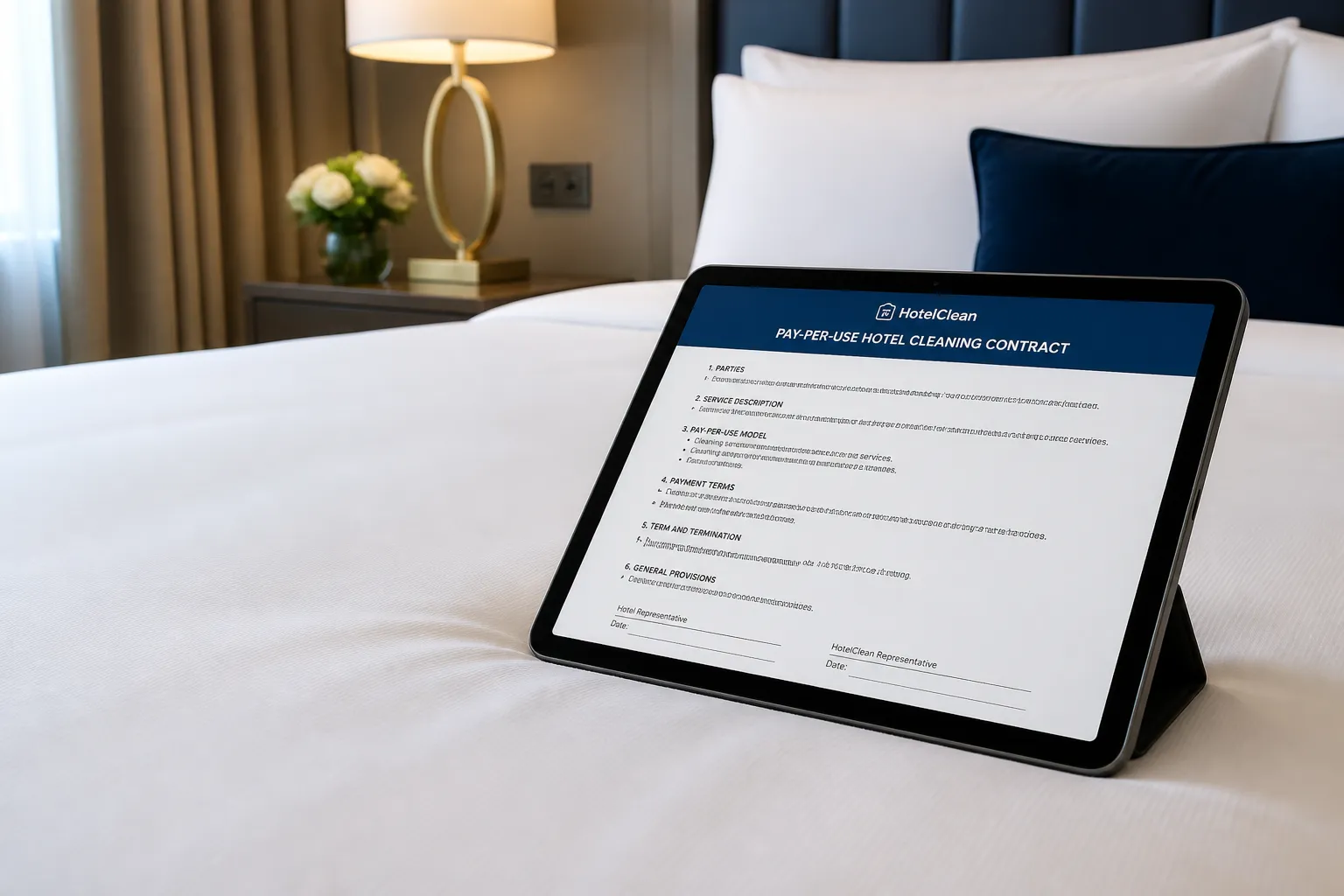
Among the various contract formats available for a hotel’s cleaning service, the pay-per-use contract is one of the least known but potentially most advantageous options for properties with highly variable occupancy throughout the year. Unlike a fixed monthly fee, this format ties the cost of the service to actual usage.
This article explains how a pay-per-use cleaning contract works for hotels and when it is worth choosing.
Contents
- What a pay-per-use contract is
- How the cost is calculated
- When it beats a fixed fee
- When a fixed fee is preferable instead
- What to check before signing
- Risks to keep under control
- How to choose the right format for your property
What a pay-per-use contract is
A pay-per-use cleaning contract calculates the service’s cost based on a variable parameter linked to actual usage, typically the number of rooms cleaned, the hours of work actually carried out, or a combination of both. Unlike a fixed fee, which stays the same regardless of occupancy, this format lets the monthly cost fluctuate according to the property’s real activity.
How the cost is calculated
Cost calculation under a pay-per-use contract is generally based on a rate card agreed during contracting: a price per room cleaned (often split between departure cleaning and daily cleaning), or an hourly rate applied to the hours actually worked by staff. Transparency in this rate card, and clarity on what is included in each line item, are essential to avoid disputes later on.
When it beats a fixed fee
A pay-per-use contract particularly suits properties with highly seasonal occupancy, like many hotels and farm stays in Tuscany, where peak-season months concentrate most of the activity and low-season months see very reduced or no occupancy. In these cases, a fixed fee would risk making the property pay for a service that is not fully used during closed or nearly closed months.
When a fixed fee is preferable instead
Conversely, for properties with steady occupancy throughout the year, a fixed fee offers the advantage of predictable spending and often more favourable pricing over the medium term, precisely because the supplier can plan its resources with greater certainty. The choice between the two formats therefore mainly depends on the property’s occupancy profile.
What to check before signing
Before signing a pay-per-use contract, it is important to check a few points: whether a guaranteed monthly minimum exists regardless of occupancy, how price variations are handled in case of sudden demand spikes, and what notice period is required to inform the supplier of expected guest numbers, an essential element for correctly planning staff.
Risks to keep under control
A pay-per-use contract, if not well structured, can create uncertainty for both parties: the supplier may struggle to guarantee staff availability during sudden peaks, while the property may end up paying higher rates than expected if the rate card was not clearly defined. Setting clear notice windows and conditions for volume changes significantly reduces this risk.
Our cleaning service offers several contract formats, including pay-per-use solutions for properties with seasonal occupancy.
How to choose the right format for your property
The choice between a pay-per-use contract and a fixed fee has no single answer valid for every property: it depends on the occupancy profile, demand predictability and each management’s risk tolerance. A direct discussion with the supplier, bringing historical occupancy data, is the most effective way to find the most suitable solution.
If you are weighing up which contract format to choose for your property, get in touch for a tailored quote.